Minborg

Minborg
Minborg
Showing posts with label MemorySegment. Show all posts

Monday, January 9, 2023

Java 20: Colossal Sparse Memory Segments

Did you know you can allocate memory segments that are larger than the physical size of your machine’s RAM and indeed larger than the size of your entire file system? Read this article and learn how to make use of mapped memory segments that may or may not be “sparse” and how to allocate 64 terabytes of sparse data on a laptop.


Mapped Memory

Mapped memory is virtual memory that has been assigned a one-to-one mapping to a portion of a file. The term “file” is quite broad here and may be represented by a regular file, a device, shared memory or any other thing that the operating system may refer to via a file descriptor.


Accessing files via mapped memory is often much faster than accessing a file via the standard file operations like read and write. Because mapped memory is operated on directly, some interesting solutions can also be constructed via atomic memory operations such as compare-and-set operations, allowing very efficient inter-thread and inter-process communication channels. 


Because not all parts of the mapped virtual memory must reside in real memory at the same time, a mapped memory segment might be much larger than the physical RAM in the machine it is running in. If a portion of the mapped memory is not available when accessed, the operating system will temporarily suspend the current thread and load the missing page after which operation may resume again.


Other advantages of mapped files are; they can be shared across processes running different JVMs and, the files remain persistent and can be inspected using any file tool like hexdump.


Setting up a Mapped Memory Segment


The new Foreign Function and Memory feature that previews for the second time in Java 20 allows large memory segments to be mapped to a file. Here is how you can create a memory segment of size 4 GiB backed by a file.


Set<OpenOption> opts = Set.of(CREATE, READ, WRITE);

try (FileChannel fc = FileChannel.open(Path.of("myFile"), opts);

     Arena arena = Arena.openConfined()) {


    MemorySegment mapped = 

            fc.map(READ_WRITE, 0, 1L << 32, arena.scope());


    use(mapped);


} // Resources allocated by "mapped" is released here via TwR


Sparse Files

A sparse file is a file where information can be stored in an efficient way if not all portions of the file are actually used. A file with large unused “holes” is an example of such a file whereby only the used sections are actually stored in the underlying physical file. In reality, however, the unused holes also consume some resources albeit much less than their used counterparts.

Figure 1, Illustrates a logical sparse file where only actual data elements are stored in the physical file.


As long as the sparse file is not filled with too much data, it is possible to allocate a sparse file that is much larger than the available physical disk space. For example, it is possible to allocate an empty 10 TB memory segment backed by a sparse file on a filesystem with very little available capacity. 


It should be noted that not all platforms support sparse files.


Setting up a Sparsely Mapped Memory Segment 


Here is an example of how to create and access the contents of a file via a memory-mapped MemorySegment whereby the contents is sparse. For example, expanding the real underlying data in the file as needed automatically:


Set<OpenOption> sparse = Set.of(CREATE_NEW, SPARSE, READ, WRITE);

try (var fc = FileChannel.open(Path.of("sparse"), sparse);

     var arena = Arena.openConfined()) {


     memorySegment mapped = 

             fc.map(READ_WRITE, 0, 1L << 32, arena.scope());


    use(mapped);

} // Resources allocated by "mapped" is released here via TwR


Note: The file will appear to consist of 4 GiB of data but in reality the file does not use any (apparent) file-system space at all:


pminborg@pminborg-mac ntive % ll sparse 

-rw-r--r--  1 pminborg  staff  4294967296 Nov 14 16:12 sparse


pminborg@pminborg-mac ntive % du -h sparse 

  0B sparse


Going Colossal

The implementation of sparse files varies across the many platforms that are supported by Java and consequently, various sparse-file properties will vary depending on where an application is deployed.


 I am using a Mac M1 under macOS Monteray (12.6.1) with 32 GiB RAM and 1 TiB storage (of which 900 GiB are available). 


I was able to map a single sparse file of up to 64 TiB using a single mapped memory segment on my machine (using its standard settings):


  4 GiB -> ok as demonstrated above

  1 TiB -> ok

 32 TiB -> ok

 64 TiB -> ok

128 TiB -> failed with OutOfMemoryError


It is possible to increase the amount of mappable memory but this is out of the scope for this article. In real applications, it is better to have smaller portions of a sparse file mapped into memory rather than mapping the entire sparse file in one chunk. These smaller mappings will then act as “windows” into the larger underlying file.


 Anyhow, this looks pretty colossal:


-rw-r--r--   1 pminborg  staff  70368744177664 Nov 22 13:34 sparse


Creating the empty 64 TiB sparse file took about 200 ms on my machine.


Unrelated Observations on Thread Confinement

As can be seen above, it is possible to access the same underlying physical memory from different threads (and indeed even different processes) with file mapping despite being viewed through several distinct thread-confined MemorySegment instances.

What’s Next?

Try out mapped segments today by downloading a JDK 20 Early-Access Build. Do not forget to pass the --enable-preview JVM flag or your code will not run.

Monday, December 5, 2022

Java 20: A Sneak Peek on the Panama FFM API (Second Preview)

The new JEP 434 has just seen daylight and describes the second preview of the ”Foreign Function & Memory API” (or FFM for short) which is going to be incorporated in the upcoming Java 20 release! In this article, we will take a closer look at some of the improvements made from the first preview that debuted in Java 19 via the older JEP 424.


Getting familiar with the FFM

This article assumes you are familiar with the FFM API. If not, you can get a good overview via the  new JEP


Short Summary

Here is a short summary of the FFM changes made in Java 20 compared to Java 19:


  • The MemorySegment and MemoryAddress abstractions are unified (memory addresses are now modeled by zero-length memory segments);

  • MemorySession has been split into Arena and SegmentScope to facilitate sharing segments across maintenance boundaries.

  • The sealed MemoryLayout hierarchy is enhanced to facilitate usage with pattern matching in switch expressions and statements (JEP 433)


MemorySegment

A MemorySegment models a contiguous region of memory, residing either inside or outside the Java heap. A MemorySegment can also be used in conjunction with memory mapping whereby file contents can be directly accessed via a MemorySegment


Some changes were done between Java 19 and Java 20 with respect to the MemorySegment concept. In Java 19, there was a notion named MemoryAddress used for “pointers to memory” and function addresses. In Java 20,  MemorySegment::address returns a raw memory address in the form of a long rather than a MemoryAddress object. Additionally, function addresses are now modeled as a MemorySegment of length zero. This means the MemoryAddress class was dropped entirely.


SegmentScope

All MemorySegment instances need a SegmentScope which models the lifecycle of MemorySegment instances. A scope can be associated with several segments, meaning these segments share the same lifecycle and consequently, their backing resources will be released materially at the same time.


In Java 19, the term MemorySession was used for lifecycles but was also a closeable segment allocator. In Java 20, a SegmentScope is a much more concise, lifecycle-only concept.


Perpetual Global Scope Allocation

Native MemorySegment instances that should live during the entire JVM lifetime can be allocated through the SegmentScope.global() scope (i.e. segment memory associated with this scope will never be released unless the JVM exits). The SegmentScope.global() scope is guaranteed to be a singleton.


Automatic JVM-Managed Deallocation

Native MemorySegment instances  that are managed by the JVM can now be allocated through the SegmentScope.auto() factory:


MemorySegment instances associated with new scopes created via the auto() method are also available to all threads but will be automatically managed by the Java garbage collector. This means segments will be released some unspecified time after the segment becomes unreachable. Thus, segments will be released when they are no longer referenced, just like ByteBuffer objects allocated via the ByteBuffer.allocateDirect() method. 


This allows a convenient create-and-forget scheme but also implies giving up exact control of when potentially large segments of off-heap memory are actually released.


Deterministic User-Managed Deallocation via Arena

Native MemorySegment instances can also be managed directly and deterministically via the Arena factory methods:


  • Arena.openConfined()


  • Arena.openShared()


MemorySegment instances associated with an openConfined() Arena will only be available to the thread that first invokes the factory method and the backing memory will exist merely until the Arena::close method is invoked (either explicitly or by participating in a try-with-resources clause) whereafter accessing any segments associated with the closed Arena will throw an exception. 


MemorySegment instances associated with an openShared() Arena behave in a similar way except they are available to any thread. Another difference is when arenas of this type are closed, the JVM has to make sure no other threads are in a critical section (to ensure memory addressing integrity while maintaining performance) and so, closing a shared Arena is slower than closing a confined Arena.


It should be mentioned that forgetting to invoke the Arena::close method means; any and all memory associated with the Arena will remain allocated until the JVM exits. There are no safety nets here and so, a try-with-resource fits nicely for short-lived arenas as it guarantees all the resources of an  Arena are released, no matter what.


An Arena can also be used to co-allocate segments in the same scope. This is convenient when using certain data structures with pointers. For example, a linked list that can be dynamically grown by creating new segments when the old ones become full. The referencing pointers are guaranteed to remain valid as all the participating segments are associated with the same scope. Only when the common scope is closed, all the underlying segment resources can be released.


In Java 19, the MemorySession was similar to the Java 20 Arena but crucially, an Arena is not a lifecycle but is now instead associated with a lifecycle (accessible via the Arena::scope method). 


MemoryLayout and Pattern Matching

In FFM, a MemoryLayout can be used to describe the contents of a MemorySegment. If we, for example, have the following C struct declaration:


typedef struct Point {

    int x,

    int y

} Points[5];


Then, we can model it in FFM like this:


SequenceLayout pints = MemoryLayout.sequenceLayout(5,

    MemoryLayout.structLayout(

        ValueLayout.JAVA_INT.withName("x"),

        ValueLayout.JAVA_INT.withName("y")

    )

).withName("Points");


Pattern matching (as recently described in JEP 427) will arguably be one of the largest improvements to the Java language ever made and of a similar dignity as generics (appearing in Java 5) and lambdas/functions (appearing in Java 8). In Java 20, the sealed hierarchy of the MemorySegment was overhauled to provide a pattern-matching-friendly definition. This allows, for example,  uncomplicated and concise rendering of memory segments as shown hereunder:


default String render(MemorySegment segment,

                      long offset,

                      ValueLayout layout) {


    return layout.name().orElse(layout.toString())+ " = " +
    switch (layout) {

        case OfBoolean b -> Boolean.toString(segment.get(b, offset));

        case OfByte b -> Byte.toString(segment.get(b, offset));

        case OfChar c -> Character.toString(segment.get(c, offset));

        case OfShort s -> Short.toString(segment.get(s, offset));

        case OfInt i -> Integer.toString(segment.get(i, offset));

        case OfLong l -> Long.toString(segment.get(l , offset));

        case OfFloat f -> Float.toString(segment.get(f, offset));

        case OfDouble d -> Double.toString(segment.get(d, offset));

        case OfAddress a -> 

            "0x"+Long.toHexString(segment.get(a, offset).address());

    };

}


The code above can relatively easily be expanded with cases for the complete MemoryLayout sealed hierarchy including recursive calls for the types SequenceLayout, GroupLayout and for the more simple PaddingLayout.


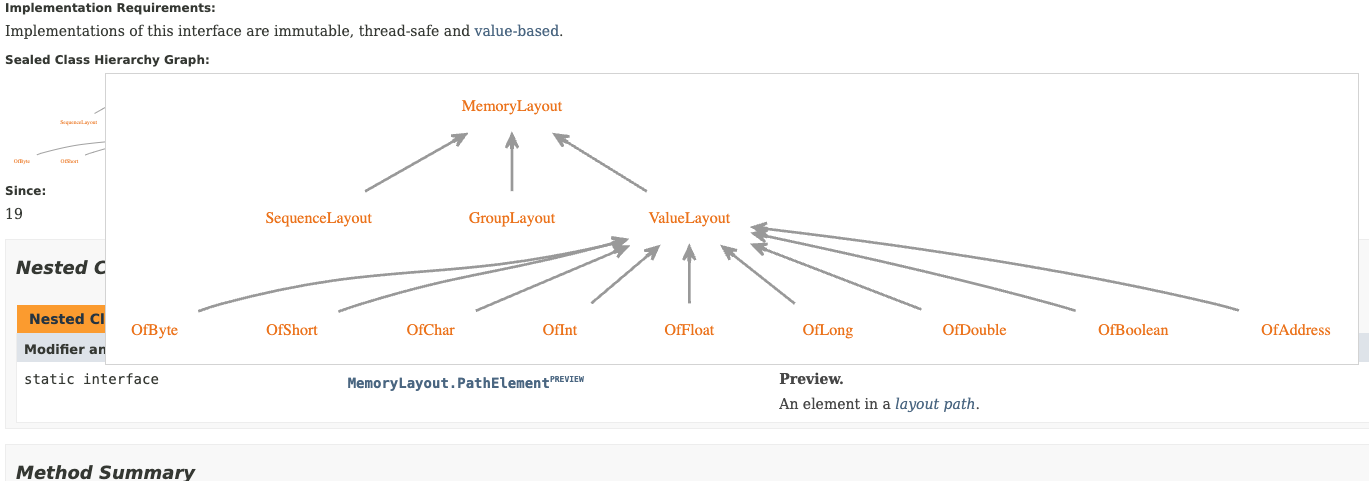
As a side note, the javadocs in Java 20 will likely come with a pattern-matching nudger in the form of a graphic rendering of the sealed hierarchy for selected classes (i.e. those tagged with “@sealedGraph”). Here is how the graph for  MemoryLayout might look like once Java 20 hits GA:


As can be seen, the graph and the pattern-matching switch example above correspond and the cases are exhaustive with respect to the ValueLayout type.


Other Improvements

Java 20 will also see many other improvements in the FFM API, some of which are summarized hereunder:


  • Reduced API surface, making it easier to learn and understand the new API

  • Improved documentation

  • Ability to access thread local variables in native calls, including errorno


Show Me the Code!

Here are some examples of creating MemorySegment instances for various purposes:


Allocate a 1K MemorySegment for the Entire Duration of an Application’s Lifetime


public static final MemorySegment SHARED_DATA = 

        MemorySegment.allocateNative(1024, MemoryScope.global());


Allocate a Small, 32-byte Temporary  MemorySegment not Bothering When the Underlying Native Memory is Released


var seg = MemorySegment.allocateNative(32, MemoryScope.auto());


Co-allocate a New MemorySegment with an Existing Segment


var coSegment = MemorySegment.allocateNative(32, seg.scope());

// Store a pointer to the original segment

coSegment.set(ValueLayout.ADDRESS, 0, seg);


Allocate a Large, 4 GiB Temporary  MemorySegment Used by the Current Thread Only


try (var arena = Arena.openConfined()) {

    var confined = arena.allocate(1L << 32);

    use(confined);

} // Memory in "confined" is released here via TwR


Allocate a large, 4 GiB temporary  MemorySegment to be Used by Several Threads


try (var arena = Arena.openShared()) {

    var shared = arena.allocate(1L << 32);

    useInParallel(shared);

} // Memory in "shared" is released here via TwR


Access an Array via a MemorySegment


int[] intArray = new int[10];

var intSeg = MemorySegment.ofArray(intArray);


Access a Buffer (of long in This Example) via a MemorySegment


LongBuffer longBuffer = LongBuffer.allocate(20);

var longSeg = MemorySegment.ofBuffer(longBuffer);


What’s Next?

Take FFM for a spin today by downloading a Java 20 Early-Access build. Do not forget to pass the --enable-preview JVM flag or the code will not run. 


Test how you can benefit from FFM already now and engage with the open-source community via the panama mailing list.